Thursday, 31 July 2014
I'm back!
I know it has been a long time since posts graced this blog, Uni life kinda took over, but thats all done now so expect to see my news, reviews and behind the scenes information on a weekly basis once again. I have really missed this, its good to be back. Guardians of the Galaxy review coming this saturday!

Friday, 16 August 2013
Sires, Narrative and Time Slideshow
There is an accompanying slide show to the madness that is Sires, here are the notes for the slideshow and a few images.
SLIDE 1
Sires
By
Robin Booker
SLIDE 2
Sires will show that the real in from is not always the most meaningful. Using 48fps long realistic shots I will tell the story of an army leader who squashes rebellion. Using 24fps close up poetic shots I will haunt Sires with the past present and future showing the emotive repercussions of war, inseparability of death and perpetual nature of life.
SLIDE2.5
THEORETICALLY
I wish to explore two oppositional views of cinema including Bazin's realism and Eisenstien’s montage within my visual style whilst using recent technological advances to push them further than before and explore which view offers more emotional response and how combining them and separating them can give different views of similar events. Using theories on perpetual death and repetition I will twist narrative in a new and interesting way to explore Stambaugh’s ideas of significant actions within repeating cycles of death such as in the Greek tale of Prometheus.
SLIDE 3
Inspired by Zeno's paradox (The direction of Time Reichenbach 1991) and Sacks' River of Consciousness (Sacks 2004) I decided to play with the format of film to create two forms of image with differing qualities of reality. Also inspired by the Wachowski's use of time manipulation to create "panels and gutters" in The Matrix (L. Wachowski, A. Wachowski 1999) I developed the two styles further into extreme close montages reminiscent of Eisenstein with visuals inspired by Pan's Labyrith (del Toro 2003) and long real takes reminiscent of Bazin.
SLIDE 4
BLUE
Realist
extreme longs
48fps
slow cuts
SLIDE 5
ORANGE
fairytale
close up
fast cuts
24fps
SLIDE 6
ORANGE
SLIDE 10
ORANGE
In the penultimate and revelatory scene Sires and his men gun down the village, bullets fly into homes, children cry in fear before their parents are overpowered and their lives ripped from them. Close up the brutal murders should look more horrific than last time to both us and Sires who sees the woman and child he recognizes from his dreams. He shoots them both. He stands still in regret.
SLIDE 11
BLUE
A long shot shows the mayhem around him as he stands statue like in horror and a rebel shoots him.
SLIDE 12
The first dream Sires had has come to life, it repeats, will he wake up this time?
SLIDE 13

The opening of the film an exclusive close up section will show the death of innocent women and children at Sires' own hand and the premonition of his death, a bullet to the chest and a bullet to the head. Yanked from one visual style to another as Sires is from dream to reality Sires discuss' the previous nights attack before preparing a strike force to kill rebel fighters in their homes.
The massacre is viewed again exclusively in the long shot style removing much of the emotion and action to the confined and hidden tents of the rebels. On the return journey to camp, the midpoint of the film, Sires is attacked, the whole scene is shot from outside of the truck. A gunshot is heard. The scene is replayed this time inside the truck, claustrophobic and messy Sires is shot. Another troubled dream to wake from, but this time to the sound of gunfire. This is the point at which the majority visual style switches to the close ups to reflect the idea of an "infinity narrative" talked about in my research.
Guns are loaded and fired, blood platters faces and mud flies up to the knees as grenades devastate the defences of Sires encampment. Gunpowder fills the air and after a hectic battle Sires men stand tired but victorious. As they drag the dead bodies onto a bonfire Sires decides he has had enough, killing the rebel fighters obviously want enough, this time he would attack their homes and their families.
In the penultimate and revelatory scene Sires and his men gun down the village, bullets fly into homes, children cry in fear before their parents are overpowered and their lives ripped from them. Close up the brutal murders should look more horrific than last time to both us and Sires who sees the woman and child he recognizes from his dreams. He shoots them both. He stands still in regret. A long shot shows the mayhem around him as he stands statue like in horror and a rebel shoots him in the chest, then head. The close ups from the first scene play again, will he wake up this time?
SLIDE 1
Sires
By
Robin Booker
SLIDE 2
Sires will show that the real in from is not always the most meaningful. Using 48fps long realistic shots I will tell the story of an army leader who squashes rebellion. Using 24fps close up poetic shots I will haunt Sires with the past present and future showing the emotive repercussions of war, inseparability of death and perpetual nature of life.
SLIDE2.5
THEORETICALLY
I wish to explore two oppositional views of cinema including Bazin's realism and Eisenstien’s montage within my visual style whilst using recent technological advances to push them further than before and explore which view offers more emotional response and how combining them and separating them can give different views of similar events. Using theories on perpetual death and repetition I will twist narrative in a new and interesting way to explore Stambaugh’s ideas of significant actions within repeating cycles of death such as in the Greek tale of Prometheus.
SLIDE 3
Inspired by Zeno's paradox (The direction of Time Reichenbach 1991) and Sacks' River of Consciousness (Sacks 2004) I decided to play with the format of film to create two forms of image with differing qualities of reality. Also inspired by the Wachowski's use of time manipulation to create "panels and gutters" in The Matrix (L. Wachowski, A. Wachowski 1999) I developed the two styles further into extreme close montages reminiscent of Eisenstein with visuals inspired by Pan's Labyrith (del Toro 2003) and long real takes reminiscent of Bazin.
SLIDE 4
BLUE
Realist
extreme longs
48fps
slow cuts
SLIDE 5
ORANGE
fairytale
close up
fast cuts
24fps
SLIDE 6
ORANGE
The opening of the film an exclusive close up section will show the death of innocent women and children at Sires' own hand and the premonition of his death, a bullet to the chest and a bullet to the head.
SLIDE 7
BLUE
Yanked from one visual style to another as Sires is from dream to reality, Sires discuss' the previous nights attack before preparing a strike force to kill rebel fighters in their homes.
SLIDE 8
BLUE
The massacre is viewed exclusively in the long shot style removing much of the emotion and action to the confined and hidden tents of the rebels. On the return journey to camp, the midpoint of the film, Sires is attacked, the whole scene is shot from outside of the truck. A gunshot is heard.
The massacre is viewed exclusively in the long shot style removing much of the emotion and action to the confined and hidden tents of the rebels. On the return journey to camp, the midpoint of the film, Sires is attacked, the whole scene is shot from outside of the truck. A gunshot is heard.
SLIDE 9
ORANGE
The scene is replayed this time inside the truck, claustrophobic and messy Sires is shot. Another troubled dream to wake from, but this time to the sound of gunfire. This is the point at which the majority visual style switches to the close ups to reflect the idea of an "infinity narrative" talked about in my research.
Guns are loaded and fired, blood platters faces and mud flies up to the knees as grenades devastate the defences of Sires encampment. Gunpowder fills the air and after a hectic battle Sires men stand tired but victorious. As they drag the dead bodies onto a bonfire Sires decides he has had enough, killing the rebel fighters obviously want enough, this time he would attack their homes and their families.
SLIDE 10
ORANGE
In the penultimate and revelatory scene Sires and his men gun down the village, bullets fly into homes, children cry in fear before their parents are overpowered and their lives ripped from them. Close up the brutal murders should look more horrific than last time to both us and Sires who sees the woman and child he recognizes from his dreams. He shoots them both. He stands still in regret.
SLIDE 11
BLUE
A long shot shows the mayhem around him as he stands statue like in horror and a rebel shoots him.
SLIDE 12
The first dream Sires had has come to life, it repeats, will he wake up this time?
SLIDE 13

There is a problem with this narrative structure, other than its complexity. Although the dreams line up in reverse the close ups in the second half of the film do not, they are forward in the narrative. The infinity image is not a perfect match to the narrative but is the source of inspiration for the structure and crossover of the dreams and visual styles.
SLIDE 14
STAMBAUGH
"“the question of how something significant can occur” when “caught in the cycles of birth and death”."
DREAM 1> CHOICE 1 = kill fighters = soldiers get attacked + sires death = DREAM 2 > CHOICE 2 = kill women and children =sires death + DREAM1
Assignment 2: Dramatising Time
1. Short Film Treatment
NAME:
Robin Booker
WORKING TITLE:
Sires
TAGLINE:
Death or dream?
BRIEF SYNOPSIS (50 WORDS):
Military General Sires faces rebellion, they attack his military encampment no matter how hard he fights back they always return. However with the perpetual repetition, bloodshed and danger can one man's conscience bear the weight? Troubled by dreams of past, present, future and death Sires is tired of fighting it’s time to stamp out the rebellion once and for all.
BRIEF OUTLINE (Circa. 500 WORDS):
A film of two extremes Sires fights back rebellion on the battlefield and in his dreams. The visual style of the film is extremely important almost more so than the narrative and is comprised of two opposing styles, firstly close ups at 24fps with a quick cut rate and a vivid saturated chroma. This visual style is largely influenced by Guillermo del Toro's Pans Labyrinth (2002 del Toro) I wish to achieve the same kind of dark fairytale aesthetic. The other visual style is almost the opposite, long takes, long shots and a realistic colour pallet will be complimented by the use of 48fps to make the shots look as real as possible. These two visual styles will mix at times and a range of mids will be used at the less essential points of the plot however some sections will use these styles exclusively.
The opening of the film an exclusive close up section will show the death of innocent women and children at Sires' own hand and the premonition of his death, a bullet to the chest and a bullet to the head. Yanked from one visual style to another as Sires is from dream to reality Sires discuss' the previous nights attack before preparing a strike force to kill rebel fighters in their homes.
The massacre is viewed again exclusively in the long shot style removing much of the emotion and action to the confined and hidden tents of the rebels. On the return journey to camp, the midpoint of the film, Sires is attacked, the whole scene is shot from outside of the truck. A gunshot is heard. The scene is replayed this time inside the truck, claustrophobic and messy Sires is shot. Another troubled dream to wake from, but this time to the sound of gunfire. This is the point at which the majority visual style switches to the close ups to reflect the idea of an "infinity narrative" talked about in my research.
Guns are loaded and fired, blood platters faces and mud flies up to the knees as grenades devastate the defences of Sires encampment. Gunpowder fills the air and after a hectic battle Sires men stand tired but victorious. As they drag the dead bodies onto a bonfire Sires decides he has had enough, killing the rebel fighters obviously want enough, this time he would attack their homes and their families.
In the penultimate and revelatory scene Sires and his men gun down the village, bullets fly into homes, children cry in fear before their parents are overpowered and their lives ripped from them. Close up the brutal murders should look more horrific than last time to both us and Sires who sees the woman and child he recognizes from his dreams. He shoots them both. He stands still in regret. A long shot shows the mayhem around him as he stands statue like in horror and a rebel shoots him in the chest, then head. The close ups from the first scene play again, will he wake up this time?
This film is to be as much an experiment as a film made to entertain, the mixing of frame rates and styles will hopefully draw academic minds towards the project as it is something rarely attempted. I also believe the vast theories of time woven into the plot will attract academic minds and those of fans of "puzzle narratives". Surely a film for an older and more mature audience I hope to create an accessible film with enough depth to warrant study
2. Outline of the theoretical focus (the main concept or issue)
I wish to explore two oppositional views of cinema including Bazin's realism and Eisenstien’s montage within my visual style whilst using recent technological advances to push them further than before and explore which view offers more emotional response and how combining them and separating them can give different views of similar events. Using theories on perpetual death and repetition I will twist narrative in a new and interesting way to explore Stambaugh’s ideas of significant actions within repeating cycles of death such as in the Greek tale of Prometheus.
____________________________________________________________________________
3. An explanation of your aims, and of how you developed your creative treatment from the initial concept or issue, as well as how you have incorporated further research
My whole project hinges on my two contrasting styles which came originally from my fascination with Aristotle's Arrow and how it links to frames per second, a relevant discussion in cinema today as Hollywood begins to experiment with using both 24 and 48 frames per second. The idea of still moments creating movement displayed in Zeno’s Paradox (The direction of time Reichenbach 1991)directly links to arguments over frames per second and many viewers have said that in 48fps things seem fast and more real. The idea that the number of frames per second changing could alter how real the image seems is somewhat supported by Sacks' In The River Of Consciousness (Sacks 2004) in which he observes the opposite, people stuck in one image and frozen in that moment in time.
The idea that the speed varies reminded me of a comment about time made by Andy and Lana Wachowski, directors of the Matrix trilogy, (The Matrix (1999) Matrix Reloaded (2003) Matrix Revolutions (2003)). In the special features on The Matrix they discuss how they sped up time and slowed down time to reflect panels and the gutters in comic books, the slow motion being the panels and the sped up being the gutter. This began the two separate visual styles in my mind, the sped up became 48fps and the slowed down 24fps a normal frame rate. Panels and gutters (the space between the panels) also reflect cuts themselves and the space between the cuts are something often discussed within film theory, this gave me the idea of using montage like sequences with extreme close ups and fast paced editing. Oppositionally for the 48fps sections I will use concepts defined by Bazin (What is cinema? 2005) that make up realistic films such as long takes and long shots. Although this separates the visual style from the gutter the distinction between the two forms in terms of film making and the experimentation with which conveys more emotion is a more interesting area to explore.
Now with the idea of using Eisentein esque montage (Eisenstein, (1977)) mixed with long takes emphasising realism I had to construct a narrative. I wanted the visuals to reflect my ideas on the two styles and therefore planned desaturated realistic visuals mixed with more poetic and fairytale visuals strongly inspired by Guillermo del Toro's Pans Labyrinth (2003 del Toro). As for story I wanted to weave time theories into the narrative and needed some way to use both contrasting narratives to make a point. Inspired by the geographical modelling of the Mobius strip narrative I created a narrative around the shape of infinity, an eight on its side. The start, end and middle are the sections where the visual styles mix, in the first half, along with mids, the realistic long shots prevail until the middle crossover, a turning point in the narrative in which the poetic shots become the most prevalent.
The narrative itself is thematically based on the inescapability of death and its haunting of the main character. Inspired by the tale of Prometheus and his punishment I worked the idea of repeated death into the narrative. Although this is often done in films and television I didn’t want exact and definitive repeats, to reflect the perpetual nature and danger of war I decided rather than him dying and repeating there would be an ambiguity surrounding his death hence the dreams. This gave me space to repeat war events but with a change in Sires’ character and actions, in Time Finitude and Finality (Stambaugh 74) Stambaugh talks about causality and how “the question of how something significant can occur” when “caught in the cycles of birth and death”. This in essence is what the film represents, Sires’ first decision to kill only the rebel fighters is informed by gruesome visions of dead women and children and the guilt from his previous life. His second choice is however informed by the dream of the attack on the soldiers and his own death in the trucks from the day/life before. The film ends with us seeing the life/dream that informs the first choice.
The article The Fate of Prometheus (123HelpMe.com 2011) talks about how for Prometheus “Each successive instance of suffering perpetuates the desire within him to succumb to his suffering, and die without repetition, but, instead, the cessation of desire and death elude him more and more.” This offers some insight and inspiration for the characteristics of Sires in my story. Originally I imagined him as a hardened veteran trying to stomp our rebellion however making him more suicidal, wanting to die to end things once and for all is a more interesting character trait. The inspiration and theory gained through both Prometheus’ tale and through the philosophical debates of Stambaugh add a lot to the understanding of the narrative however I was keen to create a film that could be read into but didn’t have to be read into. This is inspired in a backwards way by Lost Highway (Lynch 1997) a film I personally didn’t enjoy because of the need to analyse for pleasure. My aim as a film maker is to make films which can be explored but don’t have to be read into, therefore I ensured that Sires can be viewed as a straightforward narrative about repetitive war and guilt.
Bibliography
1. Reichenbach, Hans, and Maria Reichenbach. The direction of time. Vol. 65. Univ of California Press, 1991.
2. Sacks, Oliver. "In the river of consciousness." New York Review of Books 51.1 (2004): 41-45.
3. Stambaugh, Joan. "Time, finitude, and finality." Philosophy East and West 24.2 (1974): 129-135.
4. Eisenstein, Sergei. "A dialectic approach to film form." Film Form: Essays in Film Theory (1977): 45-63.
5. Bazin, André. What is cinema?. Vol. 2. Univ of California Press, 2005.
Websites
1. "The Fate of Prometheus." 123HelpMe.com. 02 May 2011 <http://www.123HelpMe.com/view.asp?id=22394>.
Filmography
1. The Matrix, (1999) Wachowski A., Wachowski L., USA, Warner Brothers Pictures
2. The Matrix Reloaded (2003) Wachowski A., Wachowski L., USA, Warner Brothers Pictures
3. The Matrix Revolutions (2003) Wachowski A., Wachowski L., USA, Warner Brothers Pictures
4. Pans Labyrinth (2006) Del Toro G., Spain Mexico USA, Estudios Picasso
5. Lost Highway (1997) Lynch D., France, USA, October Films, CiBy 2000, Asymmetrical Productions
Thursday, 15 August 2013
Narrative and Time
I did a module on narrative and time last year, it was pretty heavy going and the end product was a film proposal (I also did an analysis of time in film in general which I will release when I find). The proposal is pretty confusing to be honest and takes into account some in depth theories but I'm sure you will all get along fine, so here it is, be prepared!
NAME:
Robin Booker
WORKING TITLE:
Sires
TAGLINE:
Death or dream?
BRIEF SYNOPSIS (50 WORDS):
Military General Sires faces rebellion, they attack his military encampment no matter how
hard he fights back they always return. However with the perpetual repetition, bloodshed
and danger can one man's conscience bear the weight? Troubled by dreams of past, present,
future and death Sires is tired of fighting it’s time to stamp out the rebellion once and for all.
BRIEF OUTLINE (Circa. 500 WORDS):
A film of two extremes Sires fights back rebellion on the battlefield and in his dreams.
The visual style of the film is extremely important almost more so than the narrative and
is comprised of two opposing styles, firstly close ups at 24fps with a quick cut rate and a
vivid saturated chroma. This visual style is largely influenced by Guillermo del Toro's Pans
Labyrinth (2002 del Toro) I wish to achieve the same kind of dark fairytale aesthetic. The
other visual style is almost the opposite, long takes, long shots and a realistic colour pallet
will be complimented by the use of 48fps to make the shots look as real as possible. These
two visual styles will mix at times and a range of mids will be used at the less essential points
of the plot however some sections will use these styles exclusively.
The opening of the film an exclusive close up section will show the death of innocent women
and children at Sires' own hand and the premonition of his death, a bullet to the chest and a
bullet to the head. Yanked from one visual style to another as Sires is from dream to reality
Sires discuss' the previous nights attack before preparing a strike force to kill rebel fighters in
their homes.
The massacre is viewed again exclusively in the long shot style removing much of the
emotion and action to the confined and hidden tents of the rebels. On the return journey to
camp, the midpoint of the film, Sires is attacked, the whole scene is shot from outside of the
truck. A gunshot is heard. The scene is replayed this time inside the truck, claustrophobic
and messy Sires is shot. Another troubled dream to wake from, but this time to the sound of
gunfire. This is the point at which the majority visual style switches to the close ups to reflect
the idea of an "infinity narrative" talked about in my research.
Guns are loaded and fired, blood platters faces and mud flies up to the knees as grenades
devastate the defences of Sires encampment. Gunpowder fills the air and after a hectic
battle Sires men stand tired but victorious. As they drag the dead bodies onto a bonfire Sires
decides he has had enough, killing the rebel fighters obviously want enough, this time he
would attack their homes and their families.
In the penultimate and revelatory scene Sires and his men gun down the village, bullets fly
into homes, children cry in fear before their parents are overpowered and their lives ripped
from them. Close up the brutal murders should look more horrific than last time to both us
and Sires who sees the woman and child he recognizes from his dreams. He shoots them
both. He stands still in regret. A long shot shows the mayhem around him as he stands statue
like in horror and a rebel shoots him in the chest, then head. The close ups from the first
scene play again, will he wake up this time?
This film is to be as much an experiment as a film made to entertain, the mixing of frame
rates and styles will hopefully draw academic minds towards the project as it is something
rarely attempted. I also believe the vast theories of time woven into the plot will attract
academic minds and those of fans of "puzzle narratives". Surely a film for an older and more
mature audience I hope to create an accessible film with enough depth to warrant study
2. Outline of the theoretical focus (the main concept or issue)
I wish to explore two oppositional views of cinema including Bazin's realism and
Eisenstien’s montage within my visual style whilst using recent technological advances to
push them further than before and explore which view offers more emotional response and
how combining them and separating them can give different views of similar events. Using
theories on perpetual death and repetition I will twist narrative in a new and interesting way
to explore Stambaugh’s ideas of significant actions within repeating cycles of death such as
in the Greek tale of Prometheus.
___________________________________________________________________________
_
3. An explanation of your aims, and of how you developed your creative treatment from
the initial concept or issue, as well as how you have incorporated further research
My whole project hinges on my two contrasting styles which came originally from
my fascination with Aristotle's Arrow and how it links to frames per second, a
relevant discussion in cinema today as Hollywood begins to experiment with using
both 24 and 48 frames per second. The idea of still moments creating movement
displayed in Zeno’s Paradox (The direction of timeReichenbach 1991)directly links to
arguments over frames per second and many viewers have said that in 48fps things
seem fast and more real. The idea that the number of frames per second changing
could alter how real the image seems is somewhat supported by Sacks' In The
River Of Consciousness (Sacks 2004) in which he observes the opposite, people
stuck in one image and frozen in that moment in time.
The idea that the speed varies reminded me of a comment about time made by
Andy and Lana Wachowski, directors of the Matrix trilogy, (The Matrix (1999)
Matrix Reloaded (2003) Matrix Revolutions (2003)). In the special features on The
Matrix they discuss how they sped up time and slowed down time to reflect panels
and the gutters in comic books, the slow motion being the panels and the sped up
being the gutter. This began the two separate visual styles in my mind, the sped up
became 48fps and the slowed down 24fps a normal frame rate. Panels and gutters
(the space between the panels) also reflect cuts themselves and the space between
the cuts are something often discussed within film theory, this gave me the idea
of using montage like sequences with extreme close ups and fast paced editing.
Oppositionally for the 48fps sections I will use concepts defined by Bazin (What
is cinema? 2005) that make up realistic films such as long takes and long shots.
Although this separates the visual style from the gutter the distinction between the
two forms in terms of film making and the experimentation with which conveys
more emotion is a more interesting area to explore.
Now with the idea of using Eisentein esque montage (Eisenstein, (1977)) mixed
with long takes emphasising realism I had to construct a narrative. I wanted the
visuals to reflect my ideas on the two styles and therefore planned desaturated
realistic visuals mixed with more poetic and fairytale visuals strongly inspired
by Guillermo del Toro's Pans Labyrinth (2003 del Toro). As for story I wanted
to weave time theories into the narrative and needed some way to use both
contrasting narratives to make a point. Inspired by the geographical modelling of
the Mobius strip narrative I created a narrative around the shape of infinity, an
eight on its side. The start, end and middle are the sections where the visual styles
mix, in the first half, along with mids, the realistic long shots prevail until the
middle crossover, a turning point in the narrative in which the poetic shots become
the most prevalent.
The narrative itself is thematically based on the inescapability of death and
its haunting of the main character. Inspired by the tale of Prometheus and his
punishment I worked the idea of repeated death into the narrative. Although this
is often done in films and television I didn’t want exact and definitive repeats, to
reflect the perpetual nature and danger of war I decided rather than him dying and
repeating there would be an ambiguity surrounding his death hence the dreams.
This gave me space to repeat war events but with a change in Sires’ character
and actions, in Time Finitude and Finality (Stambaugh 74) Stambaugh talks
about causality and how “the question of how something significant can occur”
when “caught in the cycles of birth and death”. This in essence is what the film
represents, Sires’ first decision to kill only the rebel fighters is informed by
gruesome visions of dead women and children and the guilt from his previous life.
His second choice is however informed by the dream of the attack on the soldiers
and his own death in the trucks from the day/life before. The film ends with us
seeing the life/dream that informs the first choice.
The article The Fate of Prometheus (123HelpMe.com 2011) talks about how for
Prometheus “Each successive instance of suffering perpetuates the desire within
him to succumb to his suffering, and die without repetition, but, instead, the
cessation of desire and death elude him more and more.” This offers some insight
and inspiration for the characteristics of Sires in my story. Originally I imagined
him as a hardened veteran trying to stomp our rebellion however making him
more suicidal, wanting to die to end things once and for all is a more interesting
character trait. The inspiration and theory gained through both Prometheus’ tale
and through the philosophical debates of Stambaugh add a lot to the understanding
of the narrative however I was keen to create a film that could be read into but
didn’t have to be read into. This is inspired in a backwards way by Lost Highway
(Lynch 1997) a film I personally didn’t enjoy because of the need to analyse
for pleasure. My aim as a film maker is to make films which can be explored
but don’t have to be read into therefore I ensured that Sires can be viewed as a
straightforward narrative about repetitive war and guilt.
Bibliography
1. Reichenbach, Hans, and Maria Reichenbach. The direction of time. Vol. 65. Univ of California
Press, 1991.
2. Sacks, Oliver. "In the river of consciousness." New York Review of Books 51.1 (2004): 41-45.
3. Stambaugh, Joan. "Time, finitude, and finality." Philosophy East and West 24.2 (1974): 129-135.
4. Eisenstein, Sergei. "A dialectic approach to film form." Film Form: Essays in Film Theory (1977):
45-63.
5. Bazin, André. What is cinema?. Vol. 2. Univ of California Press, 2005.
Websites
1. "The Fate of Prometheus." 123HelpMe.com. 02 May 2011< http://
www.123HelpMe.com/view.asp?id=22394>.
Filmography
1. The Matrix, (1999) Wachowski A., Wachowski L., USA, Warner Brothers Pictures
2. The Matrix Reloaded (2003) Wachowski A., Wachowski L., USA, Warner Brothers Pictures
3. The Matrix Revolutions (2003) Wachowski A., Wachowski L., USA, Warner Brothers Pictures
4. Pans Labyrinth (2006) Del Toro G., Spain Mexico USA, Estudios Picasso
5. Lost Highway (1997) Lynch D., France, USA, October Films, CiBy 2000,
Asymmetrical Productions
Tuesday, 13 August 2013
Academic Evaluation of Witness
From the start of this project to the end I have been very confident in what we were planning to produce, what we were producing and our final product. Our biggest drawback is that none of us are sound engineers and struggled both in the recording and in the sound edit. However we have all kept an eye on the visuals throughout the project and the turnover itself on set has been excellent I think as a crew on the whole we worked really well together.
In the project I specifically worked on the interview scene, I storyboarded the first half of it up to the evidence bag being produced. Unfortunately on that dat we had some scheduling problems largely caused by sound, again it was one of our biggest downfalls. However I think that although I didn't get exactly what I storyboarded and we worked more for coverage we got some really nice images. I learned a lot about studio shooting, especially in the masking of the background. I am really happy with the way we got the background to complete blackness, it let us get grainless images and play with the space. It is something I will definitely consider in the future for scenes that are set in non de script dark locations. I also got to use DSLR fixed lenses, something I haven't played with before. They look really nice however I cant say that I noticed a massive difference between them and zoom lenses that are set appropriately. The fish eye was nice to experiment with however I was surprised with exactly how wide the lens was, we accidently got a few things in the shot we had to scale out.
I think our preproduction had some positives and some negatives, being a project in which we all wanted significant input it was tricky to divide up the scenes but we did a decent job of it on paper. I wanted to use a creeping track in on each of the characters for my part of the interview. Whilst simple I think that the increasing tension it would convey would have been perfect. However the project being written by Connor was really his, if anyone was the director it was him and Mark the producer. This meant that on Connor and Mark's shoots schedules were stuck to and whilst everyone had camera input they were there shoots. On our day, mine and George's I felt that we had a little of our creative control taken away because of time problems. It wasn't exactly the time shortage that caused the problems but the fact that with the time issues Mark and Connor wanted to get basic shot reverse shots before even touching the tracks and so in place of my tracking shots are a wide and a close up of each character. In post we realised that we had shotlisted way too much on the crime scene and on the interview scene, neither me or George had really considered that reconstructions would be added ontop of our scene.
Another big practical learning curve that I think comes out of the whole project is that roles must be assigned, even if they change per shoot so that everyone gets an equal input the fact that we didn't have a specific producer to do things like check equipment beforehand or a specific sound guy to test things or do foley meant we had lots of trouble. It also would have been great, and we would have had enough people, if we had split into an assistant director, a director and a camera man, I think they are the roles we got closest to but as none of use were specifically in control it made the work difficult. I think these are the reasons we had some exposure and continuity issues with some of the footage.
We got good reactions from the group about our piece, the visuals really seemed to come across strongly which was our main intention with the film. Having the visuals marked overall and being a cinematography piece we were extremely conscious of the shot composition and make up. Whilst this led to some of the aforementioned issues with the film that level of care over the visuals is something I would carry onto other projects as they look beautiful. I learned a lot about lighting on the course through subtle things such as the use of shadow and backlighting which I feel we took advantage of. This was the first time I have used the studio setting and been in such a controlled environment and the chance to really play with light was great. My personal favourite shot that I set up are the light change and the wide on Brad. I think the lighting change is effective and complies well with the brief and on the wide of Brad in the interview there is a nice side to back light which highlights him when sat back but when he leans forward they fall off as the top and other spots light the front of him. This lighting specifically I will use again, I think it looked nice on screen and was relatively easy to achieve. The only downfall of this scene is that it may be too dark, we quite like it but I'm not sure if it is too much for the general audience we are going for, it is extreme but we have used the takes that were a little brighter. I feel we may have been able to achieve a better effect by utilising more blue gels and using blue light as falloff for the dark areas therefore keeping them dark and lit rather than letting it drop off as much as we did.
We had a mixed experience with actors and props, two of our actors were fantastic, our detective and our dead body but Brad was a little over the top. I think it comes from using theatre actors but on a whole his delivery was manageable. The other issue with Brad's character is that he didn't quite act as he was intended when written, this may have been because we knew the reference material and the actor didn't, a simple thing but something so simple it slipped our minds. In future I will be sure to have a full discussion with the actors about their characters inspirations and motivations to ensure the correct performance. The props we got for the crime scene worked really well on the whole, although only cheap I feel they added an authenticity to the scene. Unfortunately we didn't have enough crime scene tape to do it properly but a lack of wides helps hide the fact. The problem we had with props was more with costume, as we didn't buy the dead body costume because it was such a small part and detail we could not ruin it with blood. This meant the blood effects on the body were a little poor, whilst the blood looked good we could only paint it on the floor up to the jacket with a centimetre space between the jacket and blood. We also couldnt put blood ontop of the jacket so there were no gunshots or blood patches representing wounds. In the edit when we looked back on shots that had the body in we realised we could not use any of them that showed the chest or head, it was just too fake. So a simple costume error really restricted the edit. Along with the continuity and sun changing issues on that scene it was extremely difficult to get a full scene together.
I think one of our downfalls was the edit, when we showed the film, we improved it afterwards a little but I think a lot of the little things on set that we didn't notice ie. continuity issues, made the edit difficult. We also had the repeated issue of too many people with different input, Steve did the majority of the edit but didn't want to have a monopoly over other peoples camera work. Whilst I am glad it was collaborative I actually think it weakens the piece and lengthened the editing process. We all had similar strong visions for the camera work that came from discussions within the group but most of us had different ideas of the edit that conflict a little. Specifically me and Steve had different views of the edit, on reflection I should have stayed out of the edit suit and let him get on with it but he asked for some help so I wanted to be there.
Due to strong pre production the project didn't change much, the script was really strong and we all immediately knew exactly what we wanted to do with it so throughout the production and post we used the script much as possible and I think our original proposal is almost exactly what we created. Again this is because of strong post production and confidence in the planned material, whilst its hard to have this confidence on all projects its something I will aim for in the future as it makes for smoother production and post production.
Our time management was a little off, we left shooting very late so that we could get the actors we wanted, this meant the edit and sound edit were really stressful. We also had a lot of problems with corrupted hard drives and sd cards, we tried to back things up as much as possible but some of the corruptions happened too early. Apart from the rushed edit I am really happy with the whole production I think we set out what we planned to, worked well as a team and are all confident we produced high quality images. I think the film is quite clearly made with an emphasis on cinematography but the simplicity of the story gives the visuals time to work. A more complex narrative or a theme or subject behind the narrative would have improved the film, as it is it is almost an exorcise in cinematography rather than a flashed out film but such is the nature of short films. I think that we have produced some good work that will definitely end up in our personal showreels but as an entertaining short it has its limits and lack of originality that we are well aware of, in the end the wish to create something visually considered outweighed the need for complexity and originality. That being said I am extremely proud of the film and would love to see it on a larger screen again when re edited and with a more professional sound quality that I am sure we will add even after the deadline to improve the film for our own purposes.
Monday, 12 August 2013
Lighting Changes in Film and Witness
Whilst it was very difficult to find theoretical texts about lighting changes some of the basics are obvious. Although often driven by narrative events lighting changes signify a move into a more internal diegetic state, a point of view, a subjective shot. We took this meaning and applied it to the lighting change in our own film.
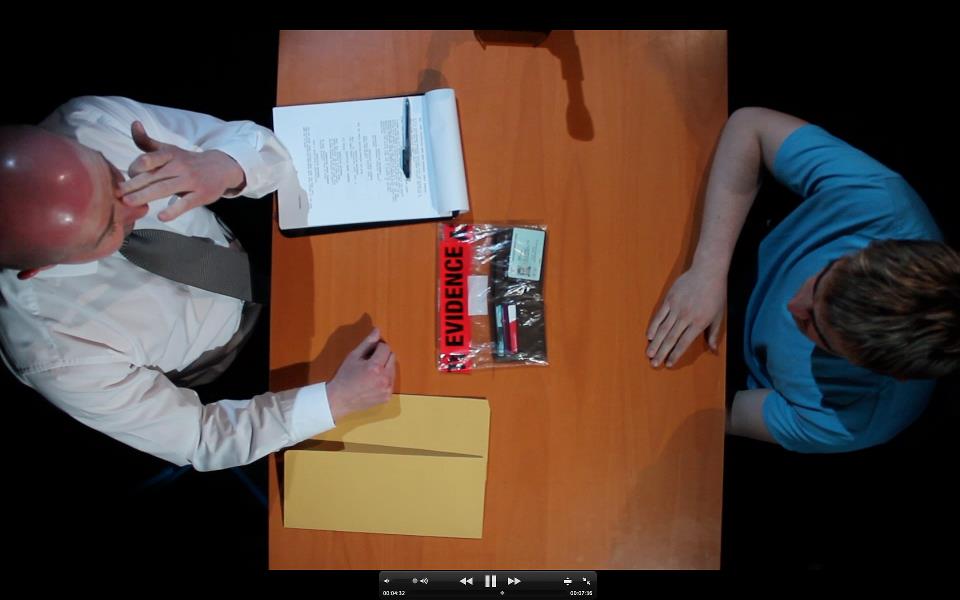
At pivotal point in the interrogation scene the detective slams an evidence bag on the table containing Brad's wallet. We go into brads mind, we see the pressure build on him represented by the harsh blue toplight on both him and the evidence bag. This was my shot to set up and I achieved the effect by lighting Brad with the top lights and then naturally washing out those specific effects with more naturalistic lighting around the scene.
I think the effect works really well, it really emphasises the pressure on Brad and emphasise that he knows its his wallet and that he is in trouble. We tried the scene without the lighting on Brad changing, just with a spot tightening on the wallet but the change wasn't drastic enough.
I think we have achieved an effective lighting change, although it isnt narratively explainable I think it is justifiable as a subjective insight into Brad's mind. We will have to cut to a reverse shot to take the audience back out of the internal diegetic shot but it should work nicely.


Sunday, 11 August 2013
Colour in Film and Witness
Colour is a massive part of cinema, its one of the key aspects of mise en scene which define the mood, themes and even tell the narrative of films. We have approached colour in various ways in our film to both create coherence and to symbolise poetic and subtle meaning.
In Syntactic Role of Colour in Film by Ornam Rotem the basics of colour in terms of film and "world building" are laid out. He first talks about the "three dimensions" of colour "varying hues, as degrees of intensity or saturation and as levels of brightness." When discussing this the the Munsell colour system comes to mind as a simple visual representation. Rotem's article goes into depth about how a colour grade can create a world; "colour, in all its dimensions, plays a crucial role in being able to give a film a sense of whole". It is clear in films that often a certain tint can be added to alter the feel. Rotem talks about using the "real world" as a reference point however he more interestingly identifies the struggles with defining real, a different philosophical debate all together. In The Matrix two clear colour tints are used as "key unifying element(s)" for the real world and the Matrix. In the following images the green tint is obvious, all of the blacks are incredibly green, this represents the green letters on monitors and the green computer program that is the Matrix. Subtle to the average viewer the hue of the tint is one of the unifying elements of the Matrix, when taken out of it and placed in the real world the image is quite different.

 In the real world a colder more metallic aesthetic is apparent, a blue is added to the majority of the grimy looking shots. The machine aesthetic is clear however it is no longer green and artificial but real cold and blue.

 Whilst neither of the worlds are the real world we see, this comparison validates the ability to compare filmic worlds and colour with real life. Most films stick to one or two tints, as Pans Labyrinth (2003 del Toro) does contrasting itself, showing two separate worlds, thematics or points of view within the film.


Another option with the overall colour wash is to subtley alter it throughout the film implying a characteristic change. This technique is brilliantly used in Mark Romanek's One Hour Photo (2002 Romanek) in which an antiseptic white becomes dulled and beige showing the characters clarity of mind despite the twisted view he has on the world. It also at times represents the fantasy in his mind and shows the settings from the view points of different characters, all elements achieved by subtle manipulation of the colour in the mise en scene.


Children of Men (2006 Cauron) uses its unifying colour scheme to represent a clear mundane and not too distant reality. All of the camera work and writing aims at realism as does the colour, a grim realism but realism none the less. However as Rotem says what is real? How do different people perceive colour? or reality? All questions on a philosophical level that question how real a films colour wash can ever be and what it can achieve.


All of the aforementioned colour schemes are clearly not all encompassing but jus some of the wash manipulations used to convey meaning and emotion and tie worlds together coherently. Rotem says that "Worlds evolve, transform and change. However we choose to talk of worlds, there seems to be no possibility of ignoring the need to recognize their marks of coherence, their internal signifiers that serve to agglutinate their disparate elements" this sums up the way "worlds" interact with colour in film and hints at the smaller, the more specific, minute objects that stand out because of colour, not world colour but specific item colour which adds completely different meaning.
When lighting our most controlled scene, the interview, we used blue gels to make the scene look as cold as possible without looking unreal. This added a harshness cold and darkness to the scene that we really loved, the light looked more like dark falloff light than actual directed light which was the intension. The coldness is the most important thing, a slightly antiseptic feel, and a really dark horrible looking room to be in.
After taking this shot we looked back at the other footage and some of it was a little washed out, we tried warming it up in the edit but decided that to build a coherent world we would make the scene a little colder with three way colour correct. This makes the whole film much more coherent and carries the cold harsh feel throughout the whole thing.


The other just as subtle use of colour is to symbolically link an item or character to an emotion. When we see colour we immediately attach meaning that is derived from what the colour connotes to you as a viewer. Some believe, like Rotem "that colours have no universal meanings and that their semantics are determined by their social and historical import". Whilst this is true it can no be disputed that in the correct environment a colour can connote something to the majority of its intended audience and therefore be used as a code to attach significant meanings to items. Context however is also important in this situation, red lips for example connote beauty however the red on a stop sign connotes danger. This simply shows that colour is part of the language film uses to suggest hidden meanings, when multiple things in the form connote the same meaning a coherent message can be read into the film.
For specific use of colour to convey subtext Brads babyish blue shows his innocence. The detective has a black and white motif showing his authority and strictness that becomes infected by the yellow folder, the point of deception and lies that corrupts his mind. The folder leads to the red evidence label clearly shows the danger to Brad.

Websites
1. Syntactic Role of Colour Rotem O., DATE!, Last Accessed 1/5/13, URL http://www.kinema.uwaterloo.ca/article.php?id=131&feature
In Syntactic Role of Colour in Film by Ornam Rotem the basics of colour in terms of film and "world building" are laid out. He first talks about the "three dimensions" of colour "varying hues, as degrees of intensity or saturation and as levels of brightness." When discussing this the the Munsell colour system comes to mind as a simple visual representation. Rotem's article goes into depth about how a colour grade can create a world; "colour, in all its dimensions, plays a crucial role in being able to give a film a sense of whole". It is clear in films that often a certain tint can be added to alter the feel. Rotem talks about using the "real world" as a reference point however he more interestingly identifies the struggles with defining real, a different philosophical debate all together. In The Matrix two clear colour tints are used as "key unifying element(s)" for the real world and the Matrix. In the following images the green tint is obvious, all of the blacks are incredibly green, this represents the green letters on monitors and the green computer program that is the Matrix. Subtle to the average viewer the hue of the tint is one of the unifying elements of the Matrix, when taken out of it and placed in the real world the image is quite different.


Another option with the overall colour wash is to subtley alter it throughout the film implying a characteristic change. This technique is brilliantly used in Mark Romanek's One Hour Photo (2002 Romanek) in which an antiseptic white becomes dulled and beige showing the characters clarity of mind despite the twisted view he has on the world. It also at times represents the fantasy in his mind and shows the settings from the view points of different characters, all elements achieved by subtle manipulation of the colour in the mise en scene.


Children of Men (2006 Cauron) uses its unifying colour scheme to represent a clear mundane and not too distant reality. All of the camera work and writing aims at realism as does the colour, a grim realism but realism none the less. However as Rotem says what is real? How do different people perceive colour? or reality? All questions on a philosophical level that question how real a films colour wash can ever be and what it can achieve.


All of the aforementioned colour schemes are clearly not all encompassing but jus some of the wash manipulations used to convey meaning and emotion and tie worlds together coherently. Rotem says that "Worlds evolve, transform and change. However we choose to talk of worlds, there seems to be no possibility of ignoring the need to recognize their marks of coherence, their internal signifiers that serve to agglutinate their disparate elements" this sums up the way "worlds" interact with colour in film and hints at the smaller, the more specific, minute objects that stand out because of colour, not world colour but specific item colour which adds completely different meaning.
When lighting our most controlled scene, the interview, we used blue gels to make the scene look as cold as possible without looking unreal. This added a harshness cold and darkness to the scene that we really loved, the light looked more like dark falloff light than actual directed light which was the intension. The coldness is the most important thing, a slightly antiseptic feel, and a really dark horrible looking room to be in.
After taking this shot we looked back at the other footage and some of it was a little washed out, we tried warming it up in the edit but decided that to build a coherent world we would make the scene a little colder with three way colour correct. This makes the whole film much more coherent and carries the cold harsh feel throughout the whole thing.


The other just as subtle use of colour is to symbolically link an item or character to an emotion. When we see colour we immediately attach meaning that is derived from what the colour connotes to you as a viewer. Some believe, like Rotem "that colours have no universal meanings and that their semantics are determined by their social and historical import". Whilst this is true it can no be disputed that in the correct environment a colour can connote something to the majority of its intended audience and therefore be used as a code to attach significant meanings to items. Context however is also important in this situation, red lips for example connote beauty however the red on a stop sign connotes danger. This simply shows that colour is part of the language film uses to suggest hidden meanings, when multiple things in the form connote the same meaning a coherent message can be read into the film.
For specific use of colour to convey subtext Brads babyish blue shows his innocence. The detective has a black and white motif showing his authority and strictness that becomes infected by the yellow folder, the point of deception and lies that corrupts his mind. The folder leads to the red evidence label clearly shows the danger to Brad.
Websites
1. Syntactic Role of Colour Rotem O., DATE!, Last Accessed 1/5/13, URL http://www.kinema.uwaterloo.ca/article.php?id=131&feature
Filmography
The Matrix (1999) Wachowski A. Wachowski L., USA, Warner Bros.
Pans Labyrinth (2006) Del Toro G., Spain Mexico USA, Estudios Picasso
One Hour Photo (2002), Romanek M., USA ,Fox Searchlight Pictures
Children of Men (2006), Cuarón A., USA, UK, Universal Pictures, Strike Entertainment, Hit & Run Productions
Children of Men (2006), Cuarón A., USA, UK, Universal Pictures, Strike Entertainment, Hit & Run Productions
Saturday, 10 August 2013
Long Takes in Film
One of the most influential and important things about long takes is the natural sense of realism they portray. This is the element of long take which we wanted to pirtray. All the way back to Andre Bazin and the Neorealism he defined long takes have been regarded as realistic however they are still varied.
One simple often used kind of long take is an extreme long static shot. This keeps all of the action in the shot and ensures that the audience know whats going on. A strong believer in the long take is Micheal Haneke, in his film Hidden (2005 Haneke) Haneke creates a film narrative with his long takes playing with the audiences beliefs as the audience watch a tape of a long shot being watched by characters. The level of realism the shot portrays transcends two levels through the film with the objective of unnerving the audience with its realism. The "look" defined by Mulvey in her "Visual pleasure and Narrative Cinema" clearly applies hear, the voyeurism portrayed in the film is what gives it its edge and the effect is created in large by the extremely long takes.
The film Children of Men (2006 Cuarón) uses similar long static takes but also uses dynamic choreography to stage long takes that follow action up to 6 minutes at a time through streets and building. Again the aim is realism however the footage has a more documentary feel, for our film the locked off shot seems more appropriate.

Filmography
1. Hidden (2005), Haneke M., France Austria, Germany, USA, Les Films du Losange, Wega Film, Bavaria Film
2. Children of Men (2006), Cuarón A., USA, UK, Universal Pictures, Strike Entertainment, Hit & Run Productions
One simple often used kind of long take is an extreme long static shot. This keeps all of the action in the shot and ensures that the audience know whats going on. A strong believer in the long take is Micheal Haneke, in his film Hidden (2005 Haneke) Haneke creates a film narrative with his long takes playing with the audiences beliefs as the audience watch a tape of a long shot being watched by characters. The level of realism the shot portrays transcends two levels through the film with the objective of unnerving the audience with its realism. The "look" defined by Mulvey in her "Visual pleasure and Narrative Cinema" clearly applies hear, the voyeurism portrayed in the film is what gives it its edge and the effect is created in large by the extremely long takes.
The film Children of Men (2006 Cuarón) uses similar long static takes but also uses dynamic choreography to stage long takes that follow action up to 6 minutes at a time through streets and building. Again the aim is realism however the footage has a more documentary feel, for our film the locked off shot seems more appropriate.

1. Hidden (2005), Haneke M., France Austria, Germany, USA, Les Films du Losange, Wega Film, Bavaria Film
2. Children of Men (2006), Cuarón A., USA, UK, Universal Pictures, Strike Entertainment, Hit & Run Productions
Bibliography
"Visual pleasure and narrative cinema." Feminisms: An Anthology of Literary Theory and Criticism Mulvey L., (1997): 438-48.
Subscribe to:
Posts (Atom)